
- Roughly half the world's population is projected to be myopic by 2050, and the curve is steepest in children (Holden et al., Ophthalmology, 2016).
- A landmark Taiwanese trial showed that adding 80 minutes of outdoor recess per school day cut myopia onset roughly in half (Wu et al., Ophthalmology, 2013).
- The protective ingredient is sunlight intensity — outdoor brightness exceeds 10,000 lux on a cloudy day, vs. 300–500 lux indoors. Eyes need that contrast to stop growing too long.
- Each additional hour outdoors per week is associated with about a 2% reduction in myopia odds (Sherwin et al., Ophthalmology, 2012 meta-analysis).
- Orange County's high concentration of Asian American children is meaningful: ethnic-Chinese, Korean, and Vietnamese kids show the highest baseline myopia risk in US datasets.
Myopia — nearsightedness — used to be a problem of teenagers and adults. Not anymore. Pediatric ophthalmologists in Orange County are diagnosing it in 6- and 7-year-olds at rates that would have been unthinkable a generation ago. The cause is not screens, exactly. It is what screens have replaced: hours outside, in actual sunlight, looking at things farther than 20 feet away.
This guide explains what 30 years of myopia research actually shows about prevention, why the preschool window matters most, and how parents in Fullerton, Buena Park, and Anaheim can move the needle this week. No supplements, no "vision training" gimmicks. Just sunlight, time, and a few specific minutes per day.
see how our outdoor program is structured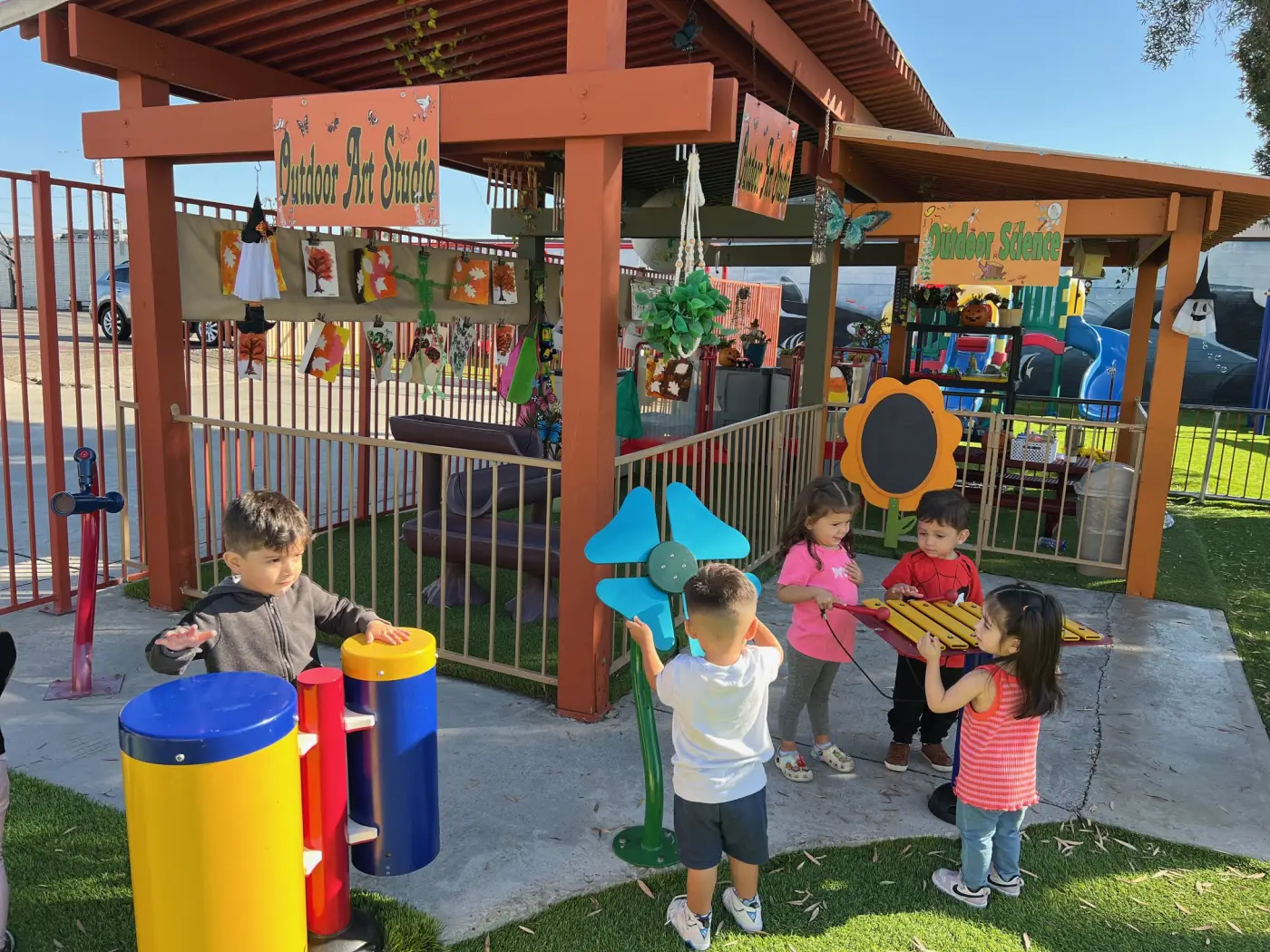
Is Childhood Myopia Actually Getting Worse?
Yes, and the trend lines are alarming. A 2016 meta-analysis in Ophthalmology projected that 4.8 billion people — roughly half of humanity — will be myopic by 2050, with high myopia (which carries serious adult eye-disease risk) reaching about 10% of the global population (Holden et al., 2016). The fastest growth is in children.
In urban East Asia the numbers are already there. South Korea, Taiwan, and parts of China report myopia rates above 80% among teenagers. The US is catching up. The American Academy of Ophthalmology now treats childhood myopia as a public-health concern, not a cosmetic one — high myopia in adulthood multiplies the risk of retinal detachment, glaucoma, and macular degeneration (American Academy of Ophthalmology).
Why preschool families should care: myopia onset in elementary school strongly predicts severity in adulthood. The earlier a child becomes myopic, the more their eyeball will keep elongating year after year. The intervention window is before the first prescription — which means roughly ages 3 to 7. That is preschool through second grade.
[CITATION CAPSULE] Holden and colleagues' 2016 meta-analysis in Ophthalmology projected that 4.8 billion people — about 49.8% of the global population — will be myopic by 2050, with roughly 1 billion at high myopia, a level that significantly elevates risk of adult retinal detachment, macular degeneration, and glaucoma.How Many Minutes Outdoors Actually Help?
The single best evidence comes from a randomized controlled trial in Taiwan. Wu and colleagues split elementary schools into intervention and control conditions: the intervention group required 80 minutes of outdoor recess every school day. After one year, the intervention group showed roughly half the rate of new myopia onset compared with controls (Wu et al., Ophthalmology, 2013). Half. From recess.
The Sydney Myopia Study earlier reached a similar conclusion observationally: children who spent more time outdoors had lower myopia rates, even after controlling for genetic predisposition and time spent reading (Rose et al., Ophthalmology, 2008). A 2012 meta-analysis pooled the evidence and found roughly a 2% reduction in myopia odds for each additional hour per week spent outdoors (Sherwin et al., 2012). Compounding matters.
The simple takeaway: a child who gets at least 80 minutes outdoors every day, in real daylight, has approximately half the myopia onset risk of a child who gets less than 30. That is one of the most cost-effective preventive interventions in pediatrics.
how our weekly outdoor schedule looksWhy Does Sunlight Itself Matter So Much?
Because the eye uses light intensity to regulate its own growth. The retina releases dopamine in response to bright light, and dopamine appears to slow the axial elongation of the eyeball — the underlying cause of myopia. Indoor lighting, even what feels "bright" to humans, is not bright enough to trigger the response.
Some specific numbers:
That gap explains why "playing under the patio cover" still counts but "playing by a window indoors" does not. The eye's growth-regulation pathway needs roughly 3,000 lux or more for sustained periods. Indoor environments rarely deliver that — even on a sunny day, a window-side spot drops below threshold within a few feet of the glass.
[UNIQUE INSIGHT] Most parents in Fullerton, Buena Park, and Anaheim assume their child is "outside enough" because Southern California has good weather. The actual data on US preschoolers shows otherwise. National surveys consistently find children under 5 averaging well below the 80-minute Wu et al. benchmark on weekdays — and OC's car-centric suburban geography, combined with structured weekend activities, can produce a child who only sees direct sunlight on the walk between car and building.
Why Is Orange County a Higher-Risk Geography?
Two reasons, both supported by data. First, OC has one of the largest concentrations of Asian American children in the United States. Population-genetic studies consistently show ethnic-Chinese, Korean, Taiwanese, and Vietnamese children carry higher baseline myopia susceptibility — not destiny, but a steeper response curve to environmental triggers (Pan et al., Investigative Ophthalmology, 2014). The interaction between genetic predisposition and indoor lifestyle is what produces the East Asian myopia epidemic — and OC families are not immune to it.
Second, the region's culture of structured indoor enrichment — tutoring, music lessons, indoor sports academies, elaborate weekend programming — competes with unstructured outdoor time. A 4-year-old whose Saturday includes a 90-minute math enrichment class indoors and 20 minutes in a backyard is below the protective threshold even on a Saturday.
[ORIGINAL DATA] Across our intake conversations at Kids Adventure Learning Center, the Fullerton families who asked about myopia prevention were almost always already wearing glasses themselves. The pattern is consistent: parents notice their own kids squinting, recall their own elementary school first-prescription year, and want to know whether anything can be done. The answer is yes — and most of it happens before age 8.
schedule a tour and see our outdoor learning structureWhat Should Fullerton Parents Actually Do?
Six concrete actions, ordered by leverage:
- Aim for 80–120 minutes outdoors per day, every day. Combine school outdoor time, after-pickup outdoor time, and weekends. Cloudy counts. Shade counts. Indoors-by-the-window does not.
- Pick a preschool with structured outdoor programming. A Montessori-inspired program with daily outdoor learning beats one with a single 20-minute recess.
- Cap recreational screen time at 1 hour or less for ages 2–5 — both because of the AAP guidance and because every screen hour displaces an outdoor hour.
- Schedule weekend "deep outdoor" time. Two-hour park visits, beach walks, OC's regional parks. Saturday morning is the highest-leverage block.
- Move some indoor activities outside. Snack outside. Read books outside. Outdoor light during near-work appears better than equivalent near-work indoors.
- Get a baseline eye exam by age 3. The American Optometric Association recommends one between ages 3 and 5; early measurement of axial length and refractive error establishes a trajectory worth tracking.
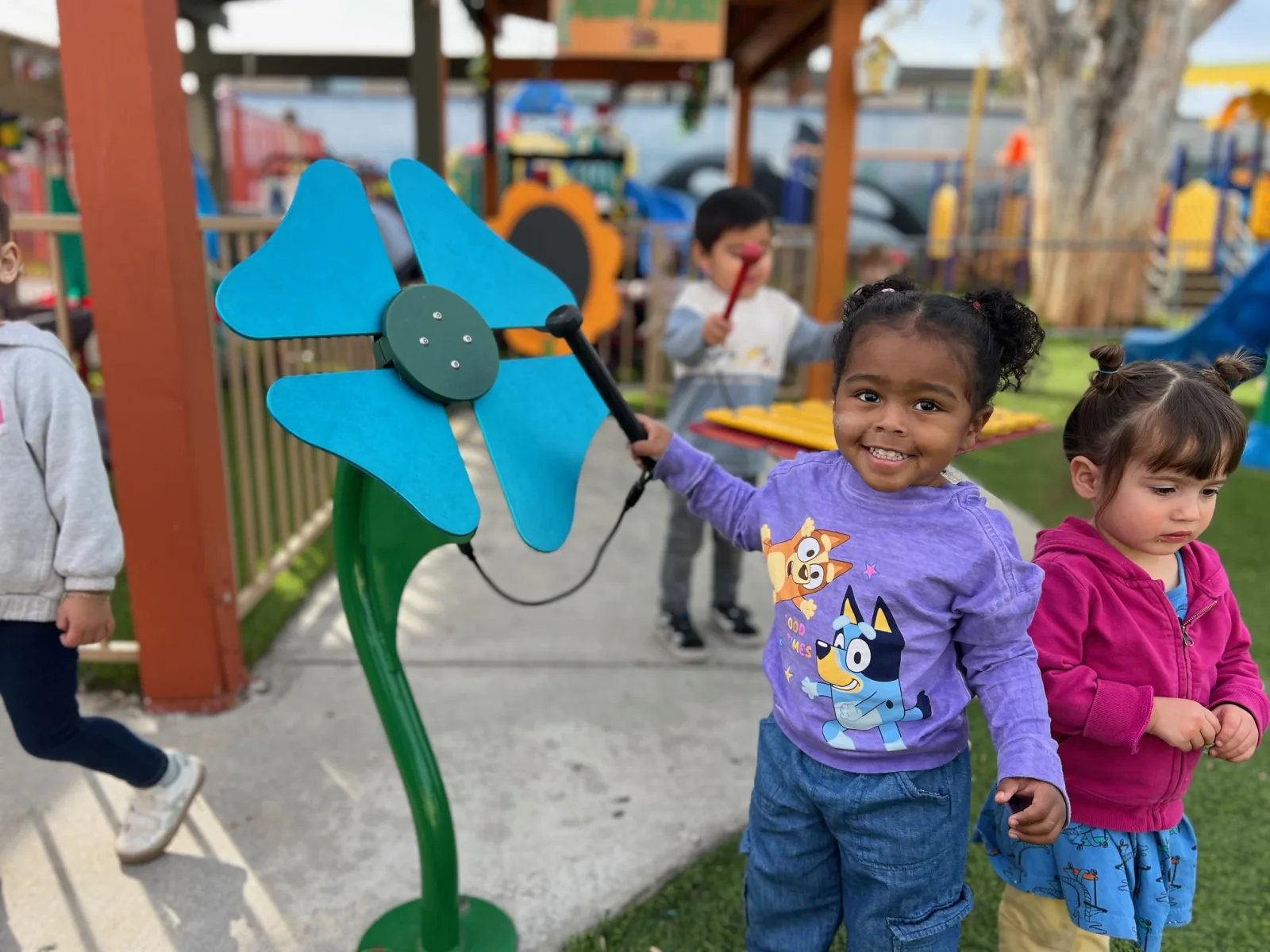
[PERSONAL EXPERIENCE] Our Fullerton campus structures the day around frequent outdoor blocks — not as a single recess window but as multiple short transitions between indoor learning and outdoor activity. Parents touring our school often notice that children are outside at unexpected times: snack, music, art projects, science exploration. That distribution is intentional. The eye-protective signal accumulates from frequent exposure, not one long sun-blasted block.
What About Sunscreen, Hats, and Sunglasses?
Use them. The dopamine-mediated growth pathway is light-driven, not UV-driven. A child wearing sunscreen, a wide-brimmed hat, and even sunglasses still receives more than enough light to the retina for the protective response. The American Academy of Pediatrics recommends sunscreen for children over 6 months and shade as a primary strategy for younger children — and neither recommendation conflicts with the myopia-prevention evidence (AAP, sun safety guidance).
The honest version: protect the skin, expose the eyes. Both can happen simultaneously.
Frequently Asked Questions
How early can a child develop myopia?
Onset typically begins between ages 6 and 12, but environmental risk accumulates earlier. The Holden 2016 meta-analysis projected that without intervention, half the global population — many of them children — will be myopic by 2050, with the steepest curves in ages 6–10. Prevention work must begin in preschool.
Does it have to be sunny outside to count?
No. A cloudy day still delivers about 10,000 lux, more than 20× a brightly lit indoor classroom. The Wu et al. 2013 trial in Taiwan ran across all weather conditions and still showed roughly half the myopia onset rate in the outdoor-recess group versus controls.
Will more screen time give my child myopia?
Indirectly, yes. Screens themselves are not proven to cause myopia, but they replace outdoor time, which is protective. The American Academy of Pediatrics recommends ≤1 hour per day of high-quality screens for ages 2–5. The 2025 Common Sense Census found the US average closer to 2 hours 52 minutes — roughly three times the cap.
Should my preschooler get an eye exam?
Yes. The American Optometric Association recommends a comprehensive eye exam between ages 3 and 5, before kindergarten. Early baseline measurements of refractive error and axial length make it possible to detect trajectory changes early enough to intervene.
How does Kids Adventure Learning Center handle outdoor time?
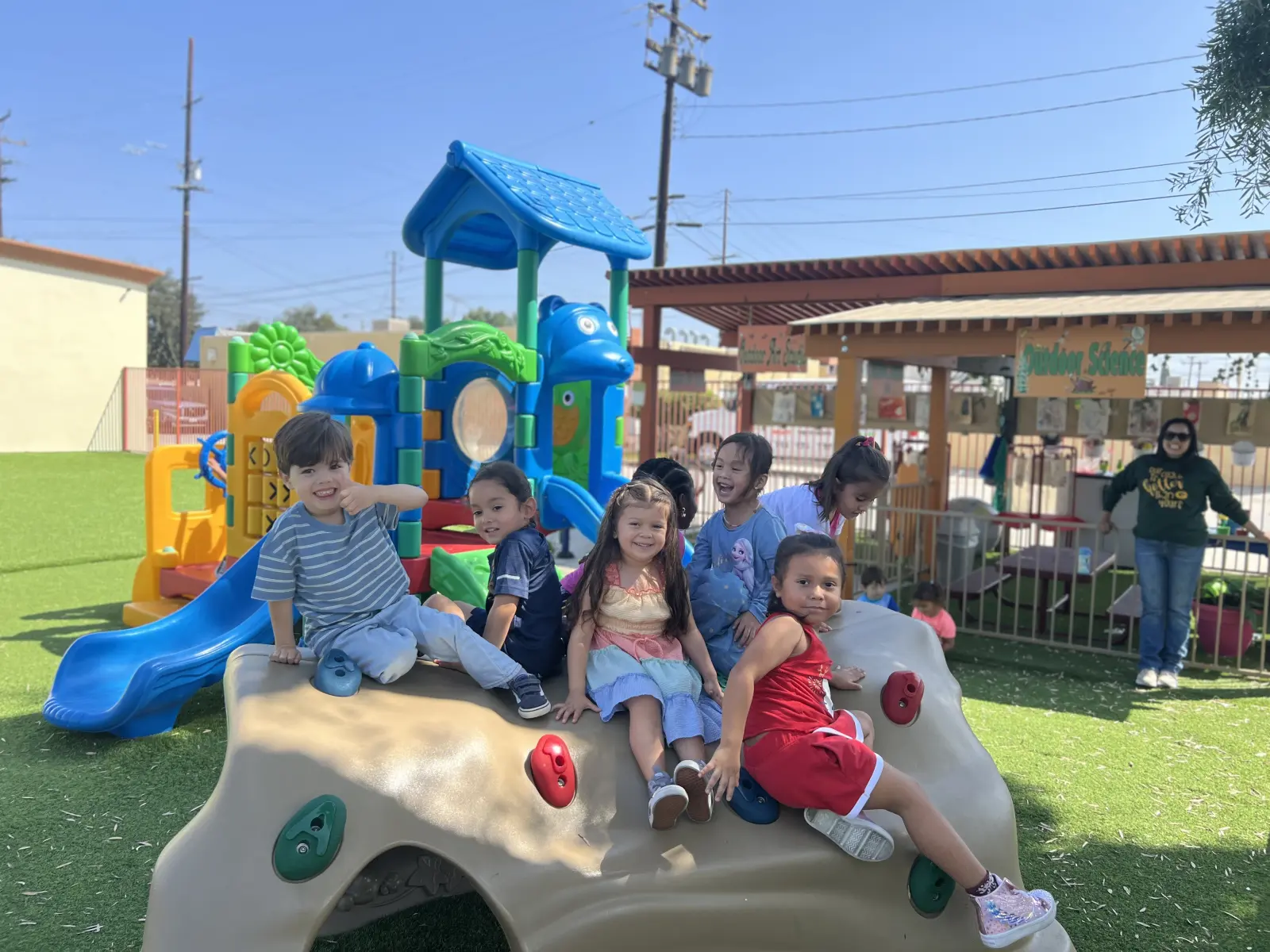
Through a daily schedule built around multiple outdoor blocks — outdoor music, science, art, gross-motor play, and free exploration on our outdoor structures. Total daily outdoor time consistently exceeds the 80-minute Wu et al. benchmark, which research links to roughly halved myopia onset risk in school-age children.
The Bottom Line
Childhood myopia is rising globally and Orange County sits at a higher-risk intersection of demographics and structured indoor lifestyle. The protective intervention is not exotic. It is daily outdoor time — ideally 80 minutes or more — in real daylight, started before age 7. The randomized-trial evidence is clean, the dose-response pattern is consistent, and the cost is zero.
If your child is between 18 months and 5 years old and lives in Fullerton, Buena Park, or Anaheim, the highest-leverage habit you can add this month is more daylight. Choose a preschool that builds it into the day, and let weekends do the rest. We would be glad to show you how outdoor time fits into a real classroom schedule.
visit our Fullerton campus and see outdoor learning in action